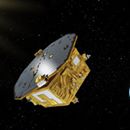

ESA creates quietest place in space
It takes an exceptionally quiet place to catch gravitational waves, to be able to detect a minuscule ripple in spacetime without any interference from external influences. In preparation for the Laser Interferometer Space Antenna (LISA), a future space-based gravitational wave observatory, the ESA – European Space Agency’s LISA Pathfinder mission created the quietest place in space – the perfect conditions for LISA to detect gravitational waves from the merger of supermassive black holes or even more exotic sources.
LISA Pathfinder, launched in December 2015, demonstrated key technologies that will be used on LISA. LISA will be the first space-based gravitational wave detector, a three-satellite fleet in a triangular formation separated by over 1.5 million miles and connected by laser beams. LISA will observe gravitational waves with periods of minutes to hours, much longer than those observable from ground-based gravitational wave observatories. Astronomers expect that this observatory will measure tens of thousands of individual signals, ranging from compact binary stars in our Milky Way to collisions of massive black holes in the distant universe. Most of these sources will be observable for months or even years, providing plenty of time for other observatories to study the same objects in complementary wavelengths of light. LISA was recently selected by ESA and is under development with a planned for launch in the early 2030s. NASA – National Aeronautics and Space Administration is collaborating with ESA and a collection of European space agencies to develop LISA and bring the gravitational wave revolution to space.
http://www.esa.int/Our_Activities/Space_Science/ESA_creates_quietest_place_in_space