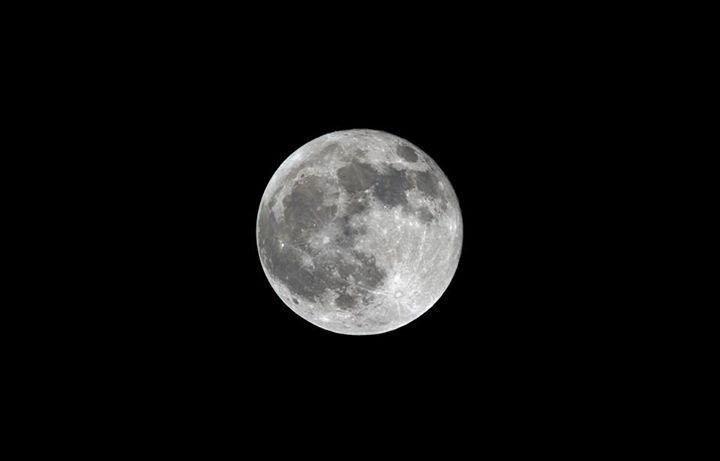
If you’ve been outside the last few evenings, you might have glanced up and even seen the Moon. You’ve probably heard about the ‘supermoon’? A supermoon is the coincidence of a full Moon or a new Moon with the closest approach the Moon makes to Earth on its elliptical orbit, resulting in the largest apparent size of the lunar disk as seen from Earth. It’s only become a popular term recently, the proper technical term is a ‘perigee-syzygy’ of the Earth-Moon-Sun system. What this means for observers on the ground is that the Moon can appear slightly bigger and brighter (up to 14% in diameter and 30% more light) than at its farthest point. However, most people viewing the Moon are unlikely to notice much difference. Depending on how you define a supermoon, there are six similar events in 2016. But the full Moon of this week, 13/14 November, will present the closest supermoon of the year (356,509 km). What’s more, the Moon won’t come this close again until the full Moon of 25 November 2034. It hasn’t been this close to Earth since January 1948.
We’re celebrating this event with a little fun: to join in, take a look outside tonight, have a listen to our new Spotify playlist, and dance with the Moon!
https://open.spotify.com/user/europeanspaceagency/playlist/0J6M71FsnEyNCbR74Q9H7E
Afterwards, check out our interactive #Moon guide: http://lunarexploration.esa.int
